

Cats have been part of our lives for a long time now, so it seems strange that there was ever a time when they weren’t.
It’s only 10,000 years ago cats started to share their lives with us. Only a blink of an eye in the grand sweep of life on this planet. Why did cats join us so late?
The answer is simple; cats were not dependent on humans for survival. They were surviving quite well on their own.
However, agriculture radically changed everything. As a result of agriculture, large quantities of grains were stored.
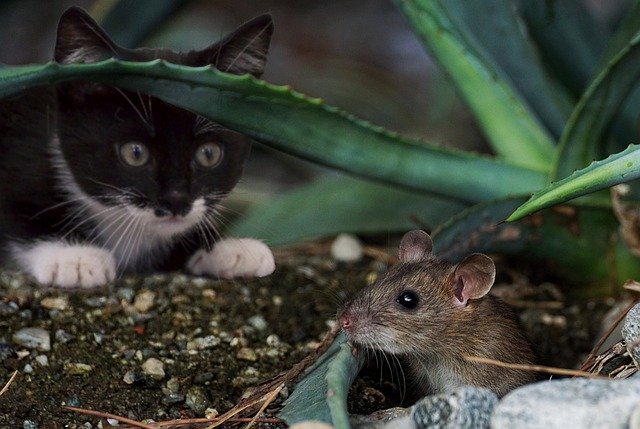
It attracted most famous freeloaders, mice, and rats—rodents like grain, which attracted cats, who enjoyed them as tasty food.
As a result, cats established residences close to human settlements. Cats, being cats, eventually made themselves at home and moved in.
What kind of cats were they?
One hint can be found in where agriculture began. In the Middle East, agriculture first took root (no pun intended) in a big way from Egypt to what is known as Turkey today.
Felis libyca is an African wild cat that lives in this region. African wild cats tend to be slightly larger than modern house cats and are yellow with muted stripes. Their behavior is almost laid back and docile.
Interestingly enough, these cats still live and hunt next to human habitations today. Locals still like to catch and rear young wild cats as pets.
These human-raised wild cats often behave very similarly to our house cats when they mature.
One can argue (and many have) that Felis libyca was the primary ancestor of domestic cats.
The domestic cat’s genetic makeup may have come from at least two other species of wild cats.
One of them is Felis silvestris (the European wildcat), which appears to have contributed darker markings and a peppery spirit to domestic cats. A third Asian species, the Pallas or Steppe cat (Felis manul), probably contributed long-haired coats to the mix.
Where It Started
The early period of domestication of cats is vague with little evidence.
A statue discovered in Anatolia (modern Turkey) shows women playing with cats. Pet cats were becoming common and loved by that time.
Around 4,000 BC, they mentioned cats in the first written records in Egypt
They commonly kept these cats in grain storage areas to hunt mice and rats. Cats in ancient Egypt had a good time.
They considered these cats to be the embodiment of the goddess Bast. Her principal temple at Bubastis had a necropolis containing mummified cats.
The Romans introduced the domestic cat northward into central Europe and westward to Britain as their empire expanded.
People admired cats for their hunting abilities. Cats continued to spread northward and eastward throughout Europe.
The Vikings kept cats as both pets and rodent hunters. In Viking mythology, Freyja, the goddess of love and war, was associated with cats. She rode her chariot drawn by giant winged cats. Brides were also given a kitten in her name when they got married.
When It Wasn’t Great To Be A Cat
Cats were in a horrible position during the middle ages.
Cats were regarded as witches’ familiars, working with the devil.
As a result of this superstition, they often killed cats during festivals. They would sometimes be burned alive or thrown from high buildings.
Europeans paid a heavy price for their cruelty to cats.
By causing the deaths of so many cats, the rodent population grew out of control, bringing the Black Death to Europe, which killed so many people.
The cats’ clean ways and hunting abilities eventually helped them rebuild their reputation among Europeans.
In the 1600s, people in France started putting tiny holes in the bottoms of their doors so that their cats could enter and leave as they pleased.
Cats were cherished pets and familiar hunters in Asia.
They were often depicted in Chinese paintings and drawings. In Japan, cats portrayed as Maneki Neko usually made up of a sitting cat with a raised and bent paw, are considered good luck.
Many businesses place them in their offices to attract money.
Cats have a fascinating history, which deserves a more thorough examination. It allows us to appreciate the unique talents and personalities of our pets.
